

Well I have some good news and bad news. The good news is if you’re reading this you didn’t get too discouraged by part 1 and you’re eager to learn more. The bad news is you have to learn 12 more chords, but wait…they’re extremely similar to the major chords. So if you we’re good about practicing the major chords these will come in seconds.

Minor Triads

Minor triads are necessary to learn because you will find them in pop pieces. A minor triad creates the dark and gloomy sound that you often hear in breakup songs. You will see minor triads written as C min, or C-. That’s about it though. So what is a minor triad you ask?! Easy!!

A minor triad is simply a major triad with a flat 3rd. So, let’s play a C major triad…hopefully you are playing the notes C, E and G, if not, please go back and visit my Major Triads post. Now all we need to do is lower the 3rd, or in this case the note E, down to an Eb….viola!! You now have a C minor triad, with the the notes C, Eb, and G. See example below.
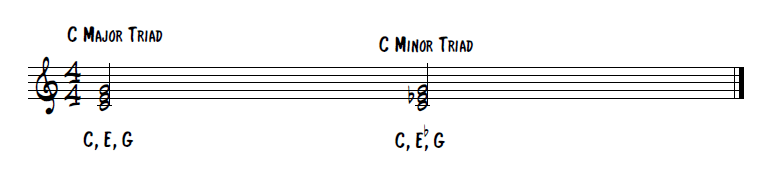
Minor and major triads
So again, in order to build a minor triad, find you major triad and flat the 3rd, or lower the middle note by one note. There you have it minor triads. Now minor triads also come from scales but again we are not diving into music theory right now. You’ll have to take my soon to be released course in order to learn that. We are simply trying to work up to a level that will satisfy your needs by playing familiar pop tunes.

Still feel overwhelmed by jazz piano?

If you’ve ever sat down to practice feeling motivated… then bounced between videos, books, and exercises unsure what actually matters — you’re not alone.

The Jazz Piano Roadmap shows you how jazz piano really works by organizing your practice around clear goals instead of random content.

Inside the Roadmap, you’ll discover:

  • Why most jazz pianists stay stuck (and it’s not lack of talent)

  • Why random practice creates random results

  • How goal-based learning leads to real confidence at the piano

  • A clear path for comping, solo piano, and improvisation

This isn’t another collection of tips.
It’s the map that helps jazz piano finally make sense.

Picture of Brenden Lowe

Brenden Lowe

Leave a Reply

Your email address will not be published. Required fields are marked *

New To Jazz Piano?

Most jazz pianists aren’t stuck because they’re lazy — they’re stuck because they don’t have a path.
The Jazz Piano Roadmap shows you exactly what to practice and in what order.

Search

Want a Clear Path Forward?

The Proficient Jazz Pianist is my complete method for building real jazz piano skills — comping, solo piano, and improvisation — without guessing what to practice next.

Popular Podcast Episodes

About Us

Jazz Piano School was created by Brenden Lowe to help pianists stop guessing what to practice and start making real progress at the piano.

Everything here is built around a clear path for the skills that matter most:
comping, solo piano, and improvisation.

The starting point is The Proficient Jazz Pianist — the core step-by-step system that lays the foundation for confident playing.
From there, students can continue into the Jazz Piano School Membership, which builds on that foundation with live learning, deeper study, and community support.

👉 Click here to explore the Proficient Jazz Pianist.

Still not sure what to practice?

The Jazz Piano Roadmap shows you how jazz pianists actually progress — with a clear, goal-based path for comping, solo piano, and improvisation.

If jazz piano has ever felt scattered or overwhelming, this will finally make it easy.

Jazz Piano School