

Well I have some good news and bad news. The good news is if you’re reading this you didn’t get too discouraged by part 1 and you’re eager to learn more. The bad news is you have to learn 12 more chords, but wait…they’re extremely similar to the major chords. So if you we’re good about practicing the major chords these will come in seconds.
Minor Triads
Minor triads are necessary to learn because you will find them in pop pieces. A minor triad creates the dark and gloomy sound that you often hear in breakup songs. You will see minor triads written as C min, or C-. That’s about it though. So what is a minor triad you ask?! Easy!!
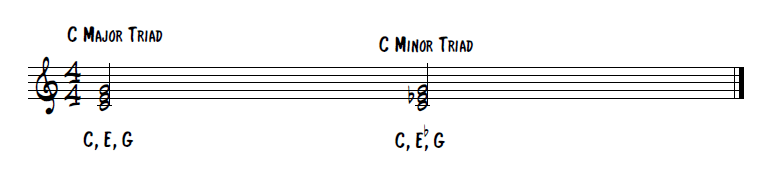
A minor triad is simply a major triad with a flat 3rd. So, let’s play a C major triad…hopefully you are playing the notes C, E and G, if not, please go back and visit my Major Triads post. Now all we need to do is lower the 3rd, or in this case the note E, down to an Eb….viola!! You now have a C minor triad, with the the notes C, Eb, and G. See example below.
Still feel overwhelmed by jazz piano?
If you’ve ever sat down to practice feeling motivated… then bounced between videos, books, and exercises unsure what actually matters — you’re not alone.
The Jazz Piano Roadmap shows you how jazz piano really works by organizing your practice around clear goals instead of random content.
Inside the Roadmap, you’ll discover:
Why most jazz pianists stay stuck (and it’s not lack of talent)
Why random practice creates random results
How goal-based learning leads to real confidence at the piano
A clear path for comping, solo piano, and improvisation
This isn’t another collection of tips.
It’s the map that helps jazz piano finally make sense.