
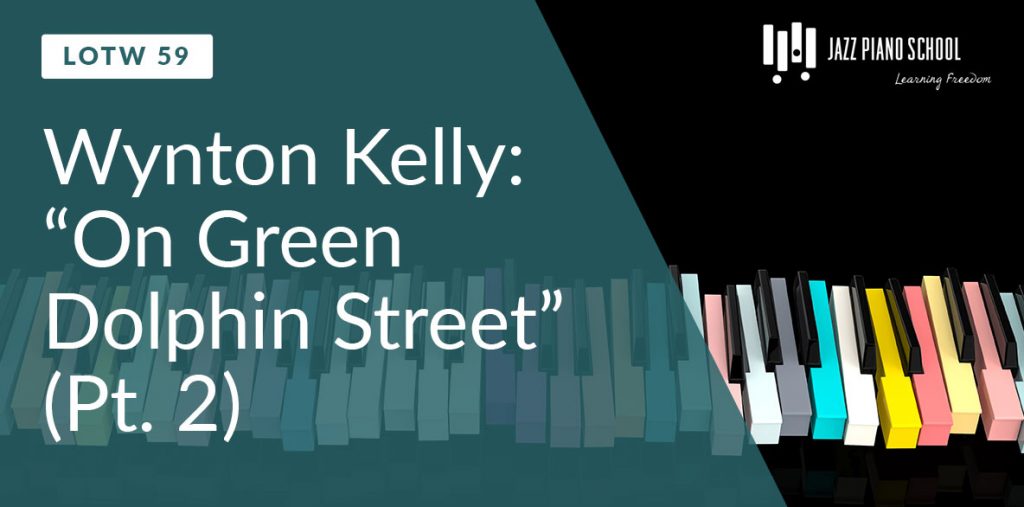
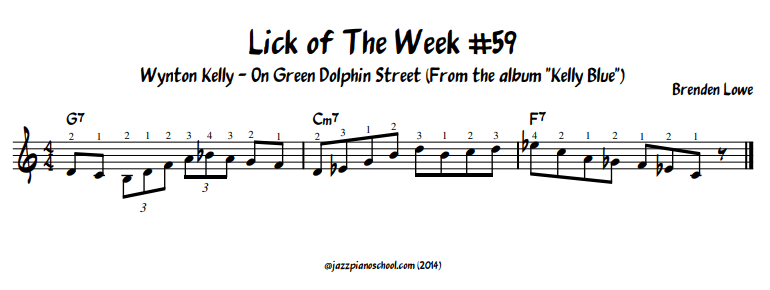
Here is the second half of the Wynton Kelly line from #58. After coming from an Eb, he resolves down into the fifth of the G7 and walks down to the third and starts a two beat triplet pattern. After doing the Wynton Kelly series, I’m sure you can see he loves using triplet patterns. You should use them as well! This triplet pattern moves up over the chord tones of G7 until he gets to the 9 and #9.

He chooses to land on a 9 over the C-7 chord, in which he then proceeds to move up the chord tones to C-7 until he gets to the 9. Very similar pattern but without the triplets. The nice change he makes here is he uses the B natural here over a C-7 which gives it a minor major sound in his solo. Very clever.

From that B natural again, he walks up to the 7th of the F7 and comes down three chord tones, Eb, C and A. Always playing lots of chord tones. Something I’m always saying if you listen to my podcasts. He resolves to the root of the F7 using the b9. This is a very nice way to approach the root over dominant 7th chords.

He then finishes up with a 7th and 1.

Points for practicing this lick:

  • Use lots of chord tone outlines with different rhythmic values.
  • Use the b9 to approach roots over dominant 7th chords.
  • Try starting on 9’s and landing on 9’s over all 7th chords.

Enjoy!
Picture of Brenden Lowe

Brenden Lowe

Leave a Reply

Your email address will not be published. Required fields are marked *

New To Jazz Piano?

Most jazz pianists aren’t stuck because they’re lazy — they’re stuck because they don’t have a path.
The Jazz Piano Roadmap shows you exactly what to practice and in what order.

Search

Want a Clear Path Forward?

The Proficient Jazz Pianist is my complete method for building real jazz piano skills — comping, solo piano, and improvisation — without guessing what to practice next.

Popular Podcast Episodes

About Us

Jazz Piano School was created by Brenden Lowe to help pianists stop guessing what to practice and start making real progress at the piano.

Everything here is built around a clear path for the skills that matter most:
comping, solo piano, and improvisation.

The starting point is The Proficient Jazz Pianist — the core step-by-step system that lays the foundation for confident playing.
From there, students can continue into the Jazz Piano School Membership, which builds on that foundation with live learning, deeper study, and community support.

👉 Click here to explore the Proficient Jazz Pianist.

Still not sure what to practice?

The Jazz Piano Roadmap shows you how jazz pianists actually progress — with a clear, goal-based path for comping, solo piano, and improvisation.

If jazz piano has ever felt scattered or overwhelming, this will finally make it easy.

Jazz Piano School