

Alright so here we go! If you’re one of those people who has played piano before and want to be able to play the pop songs you hear in your car while driving to work, or you’re a jazz lover wanting to play classic Broadway standards, let me tell you….this is the post series for you! I’m going to explain what chords are, how to read a pop or jazz chart, and how to play so it sounds good!
The only stipulation is this post will probably require a very slight knowledge of music and some previous piano lessons in order to understand what I’m saying. That being said, I will still attempt to make it as simple as possible without completely starting from scratch.
Chord & Scales
Chords are the combination of notes put together from a scale. That’s it, next!
Just kidding. So chords are built using notes from a scale and sometimes the other way around.
Chords and scales share a very intimate relationship. That’s why there have been tons of books written about scales and chords that make no sense at all to most people. This will be a lot easier than those books…I swear.
So, in order to under stand major and minor chords you somewhat have to understand the scale they come from.
Let’s start with the major scales. One note on dreaded scales quickly before we begin. Scales is one of the number one reasons why people quit playing piano or music in general. They don’t understand how it translates to music.
I will always relate music to a language because that’s what it is in the form of sounds, not words. When you learn a language you have to practice all your nouns, verbs and adjectives, in order to be able to put together a complete sentence.
Becoming discouraged and quitting because you think you don’t need scales or they’re not necessary is like saying I’m not going to learn how to say words in another language. They are an absolute essential part of learning music. If you quit without learning scales you simply didn’t want to learn music enough in the first place. Is that harsh?
The truth hurts. Scales here we go!
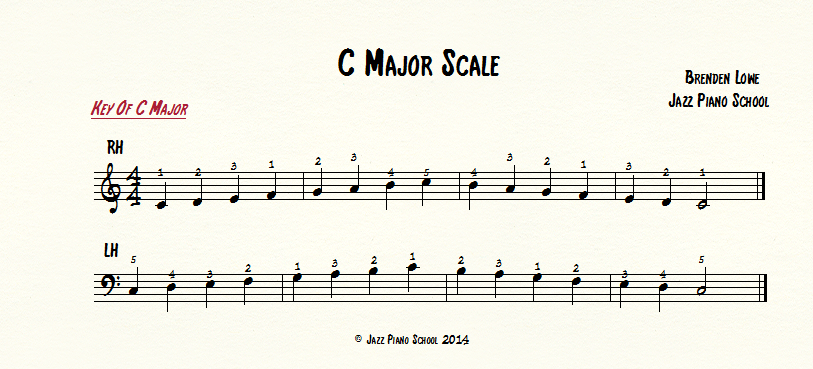
Below is the C Major Scale. From this scale we can begin to build a C Major Chord using the 1st degree of the scale, (note C), the 3rd degree of the scale, (note E), and the fifth degree of the scale, (note G). Thus building a C major chord, (C, E, G). See below.
Now I can teach you all the scales so you can find the major chords by playing the 1st note, 3rd note, and 5th note, orrrrr, I can just give you all the chords so you can practice them by playing certain exercises which will take a tenth of the time.
Let’s do that! Click on the link below to download or view the pdf for the exact exercises to play in order to learn all the major triads.
Your LH?
Quick and easy. For now, all your LH will do is play single bass notes or roots as your RH plays the chord. I guess I should tell you want bass notes are also known as roots.
Bass notes, aka roots, are simply very very low notes on the piano, (lowest you can find). These notes also correspond to the letters of chord you are playing. For example if you you are playing a C chord with your RH, you would play a low C note or C octave in your LH. See example below.

Reading Charts
So you can pull out any of the pop chart books that you have, or any guitar charts that you can find online that have chords and you will now be able to play them!…assuming you have gone through the major triad exercises that I posted above.
Also you haven’t learned minor triads, but that will be next!
Find a pop chart you have been wanting to play and put it on your piano. Now at the top of the chart you should see little letters above the written notes, or you might see just letters above the lyrics. These letters are the symbols for the chords that go in that spot. See examples below.
Piano Man, (Guitar Chart)
Piano Man (Sheet Music)
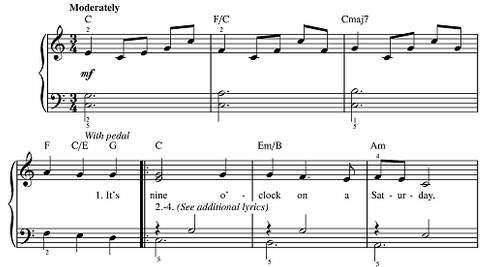
In order to start playing the harmonies of the song all you have to do is play the written chord in your RH, and the root in your LH.
Let’s look at Royals, by Lorde. There are basically only four chords to this whole piece. Once you learn to play these four chords, you have learned the piece.
See the example below for how you would play Royals.

What you play!

Obviously this is a very basic way of playing the harmonies to a piece, but this post is just the start. We will have you sound like a pro in 4 more posts, guaranteed!
Still feel overwhelmed by jazz piano?
If you’ve ever sat down to practice feeling motivated… then bounced between videos, books, and exercises unsure what actually matters — you’re not alone.
The Jazz Piano Roadmap shows you how jazz piano really works by organizing your practice around clear goals instead of random content.
Inside the Roadmap, you’ll discover:
Why most jazz pianists stay stuck (and it’s not lack of talent)
Why random practice creates random results
How goal-based learning leads to real confidence at the piano
A clear path for comping, solo piano, and improvisation
This isn’t another collection of tips.
It’s the map that helps jazz piano finally make sense.