


By Sam Griffith
Jazz piano comping can be extremely difficult. When accompanying other musicians, pianists have a lot to think about! Here are a few things to ALWAYS remember:
Keep It Simple!
This process always begins with finding the right notes AND playing them in time. This is not always easy, but very important to remember! Playing the “right” notes will do you little good if it is even a few seconds too late. Searching for the flat 9th on a C7 chord will do you little good if the rest of the band has already moved on to the next bar and a new chord. How can we always keep things in time?
Simplify! Start with simple shell voicings that only use the root or combinations of the root-3rd, root 7th. It’s okay to mix-and-match voicings when sight-reading music or playing songs you aren’t comfortable with yet if it keeps things IN TIME.
If the song you are playing is moving too quickly, then follow these steps:
-
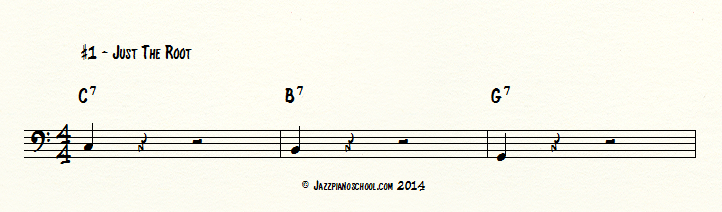
- Just play the root in the left hand. If you do this for an entire chorus, it WILL sound weird. But, if a particular sequence or progression is weird, substituting one chord for just the root will be okay the first time around.
-
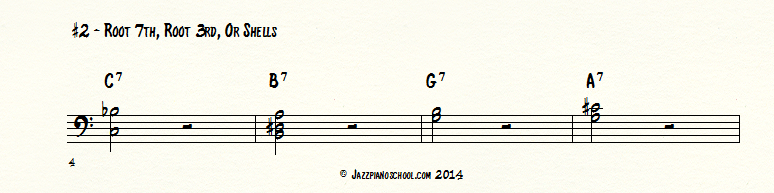
- Just play root/3rd or root/7ths combinations in the left hand. Don’t worry about trying to get ALL of the chord tones. Build up to it so that the second or third time you play through the chorus you are comfortable with the tempo, then you can add in the remaining notes.
- Demphasize the chords you are more comfortable with so you can focus on the trickier ones. If G7alt continually messes you up, lay out the chord before playing. Prepare for the G7alt chord and get it comfortably in time.
With this focus on playing the chords IN TIME first, and then correcting harmony second, you’ll have greater success!
Always Consider Your Comping Register
Pianists are very fortunate to have an expansive range that requires little (or no) physical effort to play. Use this to your advantage!
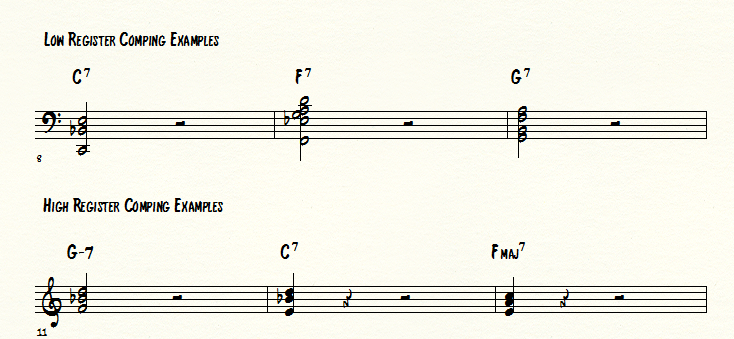
When playing behind trumpet or saxophones that are in the higher registers (generally an octave-2 octaves above middle C), stay out-of-the-way! Explore open voicings in the lower register that fills out the sound instead of playing ideas in the same register as the other instruments.
What are you doing?
No, seriously, what are you doing? When you are comping, WHAT are you doing?
It’s VERY easy to go on autopilot when you are accompanying musicians, ESPECIALLY Jazz musicians. When you’ve reached the 27th chorus of a blues, it’s incredibly easy to forget what you are doing. You are SUPPORTING the soloist. For better or worse, that is your role. Don’t fall into the trap of thinking too much about the chords and losing track of how important you are to the success of the group. Find different ways of supporting the soloist!
It is very common for the pianist (or guitarist….sometimes the bassist….and even in some cases, the drummer!) to drop out during the course of the song. Sometimes this way has a legitimate basis, such as a texture change. Sometimes it has no basis. Only, and I stress ONLY, drop out if person you are accompanying is a strong performer and doesn’t need support.
If the performer is weak, then they need you! Make the form VERY obvious. Use melody notes as the top notes in your voicings. Look for rhythmic ideas that are used when playing the melody and include those as part of your comping.
Enjoy!