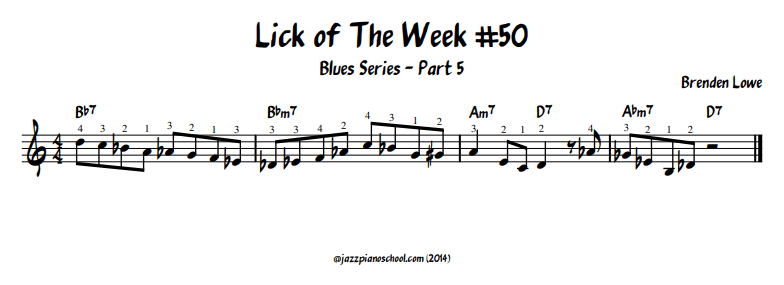
I really like this line a lot because of the bebop components in it. We start off with our bebop scale which adds a passing tone in between our 1 and b7 of our mixolydian scale. I’ve reharmonized the 6th measure to be a Bb-7 chord like in a Charlie Parker blues head or Blues For Alice. We land on the third of the Bb-7 and make our way up some chord tones and finally approach the root of the A-7 and the D7, then simple do the same thing down a half step but with a different rhythmic figure. Hope you enjoy this one!
Points for practicing this lick:
Reharm the blues to create different lines
Use same melodic patterns with different rhythmic figures to spice up your solo
Bebop scale over dominant chords is a great tool. Add passing tone in between the b7 and 1
Most jazz pianists aren’t stuck because they’re lazy — they’re stuck because they don’t have a path. The Jazz Piano Roadmap shows you exactly what to practice and in what order.
The Proficient Jazz Pianist is my complete method for building real jazz piano skills — comping, solo piano, and improvisation — without guessing what to practice next.
Jazz Piano School was created by Brenden Lowe to help pianists stop guessing what to practice and start making real progress at the piano.
Everything here is built around a clear path for the skills that matter most: comping, solo piano, and improvisation.
The starting point is The Proficient Jazz Pianist — the core step-by-step system that lays the foundation for confident playing. From there, students can continue into the Jazz Piano School Membership, which builds on that foundation with live learning, deeper study, and community support.
A simple framework for all levels that shows you exactly what to practice, what to ignore, and how to reach your playing goals in the shortest amount of time.