

So maybe you’ve read my posts on triads and 7th chords. Hopefully you have. Hopefully you have practiced the triads and 7th chords. If you have, then you are ready for this post! If not, you can still learn from the post, you will just need to learn your chords first before reading any charts.
First of all, a jazz fake book is a compilation of jazz tunes and standards that people will play on gigs or in sessions. It is a book of all the popular jazz tunes one might play. It is not written like classical music though. When you buy a fake book, ( which you should, and I’ll tell you which one later), you will see two things in a tune. A melody, and above the melody you will see chord symbols that tell you which chords to play. So step #1 to get started playing these pieces is for your LH to play the 7th chords and your RH to play the melody. If you know your 7th chords well enough in your LH and can sight read a little bit then you should have no problem with this step. Take a look at the first four bars to a jazz standard called “All The Things You Are”.
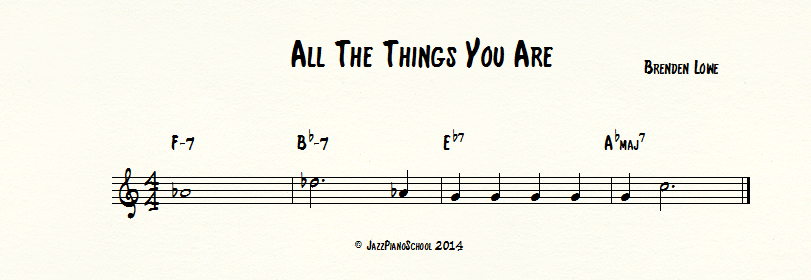
In order to play this your LH would play the 7th chords that are symbolized above the melody, while your RH plays the melody. That’s it! That’s all there is to playing jazz standards by yourself at a piano. Obviously there are certain techniques to making these sound better, but this technique is the foundation we will work from in order to progress. So, like I said, in order to play the chords in your LH you have to learn all your 7th chords and be able to play them well enough so that when you see the symbols, your LH can immediately go to the chord without fumbling.
Now when you first start learning a tune you should always start by playing your RH alone. The melody is going to be the most important quality of the piece. Once you have learned the melody and can play it with ease will want to add your LH alone, just the chords. Practice the chords alone in your LH slowly, in time, with a metronome. Set a goal to be able to go through the whole tune by playing chords in whole notes or half notes depending upon if there is one chord per measure or two chords per measure. After you can go through the entire tune without stopping or messing up, I would begin to add hands together. This is when youre RH would play the melody and your LH would play the chords.
And that’s it! You’re now officially playing jazz! Congratulations. We will definitely get into more techniques and strategies to make it sound better, but be happy that you can flip through the fake book and play most of all the pieces in there. We haven’t yet talked about -7b5 chords which you will see sometimes. I’ll write another article which explains what these chords are exactly.
What fake book do I buy?
You should start by buying the original “Real Book, Edition 1”. You can find this online if you google it. This book was actually thrown together by some berklee students who transcribed melodies from recordings and put it into a book. There are a couple wrong changes here and there but will worry about those later.
So hope this helps answer some questions about playing jazz charts. Goodluck!
Happy Practicing!
[Tweet “Didn’t know there were fake books? Check out how to spot them! #jazzpiano #jazzpianoschool”]
Feel free to subscribe to our email tips and bonus content. Simply click below.
[ninja-popup ID=380] [/ninja-popup]