
Rhythms are the last key ingredient to being able to play any song of your choice and make it sound decent to the average listener. Rhythms will be serve a large role when I begin talking about Jazz more but for now the simple rhythms you will learn to play will help you spice up the the chords you have learned already.
In the last post in this series about playing Hands Together I simply explained how to play whole notes with right hand and left hand. Now I”m going to provide you with some more interesting techniques you can use to play.
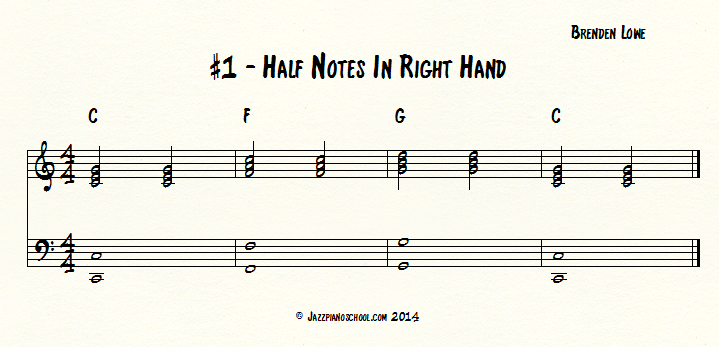
#1 - Half Notes
This example simply uses half notes in both hands instead of whole notes. Now we are simply playing the same chord twice in one bar. See the example below.
#2 - RH Quarter Notes, LH Half Notes
This is a great technique that will make you sound like a professional pianist in no time. With your right hand you are simply going to repeat your chord as quarter notes. If you see a measure of a G chord you would simply play 4 G chords in your right hand, each chord being a quarter note. See example below.
#3 - RH Half Notes, LH Quarter Notes
This rhythm is very similar to the previous example except the LH plays the quarter notes now. Your RH only plays half notes with the designated chords. See below for the example.
#4 - Rhythm 4
This rhythm and technique starts off by arpeggiating your RH chord. On beat 3, after the arpeggiation you play the full chord with your RH while your LH plays a bass note or octave of the bass note. This is a great texture for slow, airy tunes. See example below.
These will serve you very well to get started. Later I will post a more advanced rhythm section on how to combine both of your hands together.
Remember, practice and hard work is what makes 95% of people good at a hobby, not pure talent. PRACTICE HARD!
Still feel overwhelmed by jazz piano?
If you’ve ever sat down to practice feeling motivated… then bounced between videos, books, and exercises unsure what actually matters — you’re not alone.
The Jazz Piano Roadmap shows you how jazz piano really works by organizing your practice around clear goals instead of random content.
Inside the Roadmap, you’ll discover:
Why most jazz pianists stay stuck (and it’s not lack of talent)
Why random practice creates random results
How goal-based learning leads to real confidence at the piano
A clear path for comping, solo piano, and improvisation
This isn’t another collection of tips.
It’s the map that helps jazz piano finally make sense.