

When I was a young lad studying jazz piano with the great George Russell Jr. back at New England Conservatory in Boston, he had me doing all these exercises playing the shells. While I practiced, I couldn’t help but think, “This is the most pointless practicing ever.” Little did I know he was giving me gold and I didn’t even know it.
What are the “shells”?
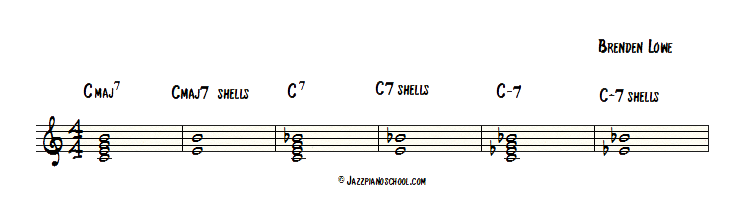
The shells of any chord are the 3rd and 7th. These two notes play a very important role in the harmony of the chord. Arguably the most important role. They dictate the exact sound and quality of the chord. If these notes are changes, you are going to come up with a completely different sounding chord. If we take a Cmaj7 chord and change the 7th to a flat 7 we have a dominant chord. If we take the third and flat it, then we now have a C-7 chord. So as you can see depending upon the shells of the chord you are going to dictate the quality of the chord.
Why are they important?
The shells are important because these are the notes that flow effortlessly into the next harmony. For example when you have a 2-5-1 progression and just play the shells. You can clearly hear how all the voices are molding into the next one to create this beautiful flow of music. Your ear must be able to hear these movements. Your hands must be able to play these movements, and while you’re soloing you must be conscious of the movements as well.
How to practice your shells.
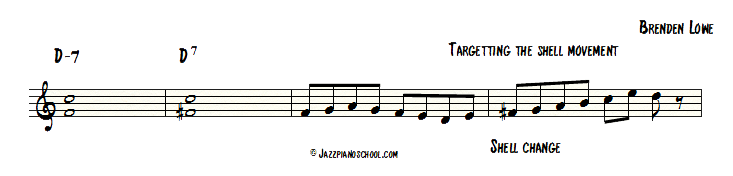
In any tunes you play you should practice your shell movement in both hands. Your left hand should play through the tune and voicelead the shells. Then your right hand should do the same. Being able to play the shells will instantly give you better comprehension of the harmonies and how the tune is flowing. It will allow your ear to hear certain movements that are important as your soloing. For example if a progression changes from D-7 to D7, you’re going to want to reflect this shell change while improvising because it is an important part of the harmony. Otherwise the movement get’s lost and it sounds like your solo is vaguely wandering around like a nomad.
Shells in your improvisation
Like I mentioned before, knowing the movements of the shells is great to improve your soloing. For example in 2-5-1’s if you know which notes are moving you can specifically target those movements in your solo and it will coincide with the harmonies. In a 2-5-1 , your 7th of the ii-7 chord is going to resolve into the 3rd of the dominant 7th chord. Then your 7th of the dominant chord is going to resolve into the third of the major 7th chord. When are you aware of these little movements through an entire piece you will be playing within the harmonies much more so then simply guessing at chord scales and notes that might sound good.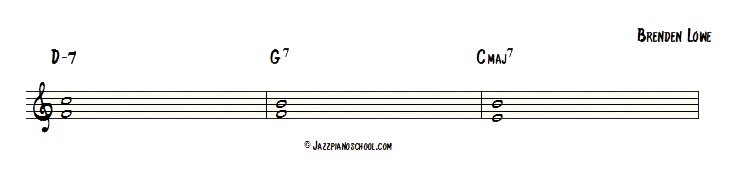
Shells for two hand voicings
Shells are also great for building two hand voicings. I haven’t spoken much of two hand voicings yet but here we go! Basically all two and one handed voicings will have the shells in them. That’s how important it is for them to be in the voicings. Remember they dictate the quality of the chord so without them, the harmony is lost. A great way to begin some simple two handed voicings is to play the shells in your left, while your RH plays octave roots. You can create simple rhythms that fit with the piece and this two handed voicing style will sound great when you’re comping for someone. We will definitely get into more advanced two handed voicings with the shells, but for now, give this a spin.
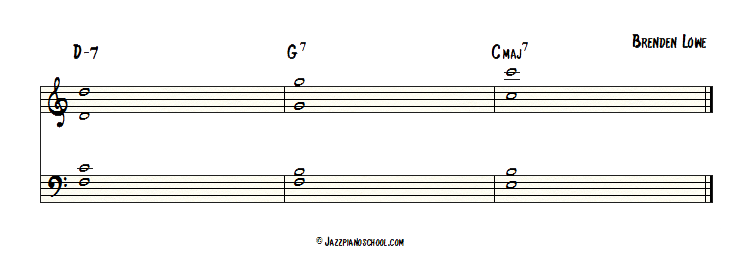
Happy Practicing!
[Tweet “This blog post is great! Check it out. #jazzpiano #jazzpianoschool”]
Feel free to subscribe to our email tips and bonus content. Simply click below.
[ninja-popup ID=380] [/ninja-popup]



5 Responses
Hello,
I just posted a music notation of the
ii – V – I shells in all keys at musescore.com
Here is the link: https://musescore.com/user/226626/scores/240801
Enjoy
Jerry
I will right away seize your rss as I can’t find your email subscription link or newsletter service. Do you have any? Please permit me understand so that I could subscribe. Thanks.
Hello! You can subscribe to our materials here. https://www.youtube.com/user/jazzpianoschool?sub_confirmation=1
I gotta favorite this website it seems very helpful very helpful
Thanks for the supportive comment! Glad we could help!