


Polychords are a simple yet effective way to enrich your harmonic vocabulary and access extended or altered tones. In a basic sense, a polychord is superimposing a chord over a chord.
In notation, a polychord may be used to:
- simplify the construction of chords
- clarify applications when improvising and composing
- imply a specific voicing
As a sight-reader, you should be comfort able reading complex altered/extended chords in standard notation (ex: C7b9#11) as well as polychord notation (ex: “Gb over C7”). However, rarely will you see a chord notated as a polychord – thus, in order to incorporate polychords in your playing, you must practice translating a traditionally notated chord into a polychord.
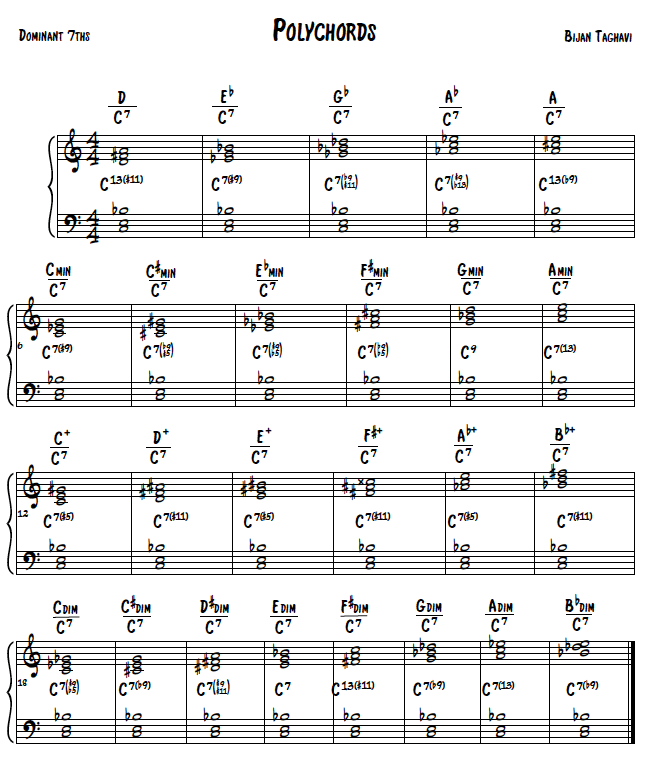
Check out these possible polychords for a dominant 7th chord, as I superimpose upper-structure major, minor, augmented, and diminished triads to achieve an extended or altered sound over C7:
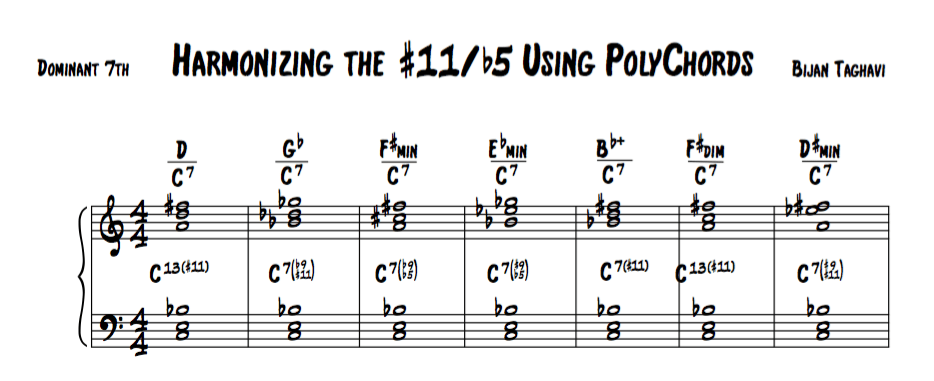
Inverting the upper-structure triads opens up many possibilities for harmonization. Using the polychords from the previous example, here are some ways to harmonize a C7 with the #11/b5 on top.
Experiment with these voicings! Try harmonizing or re-harmonizing the melody to a jazz standard using polychords; also, try writing an original composition using polychords. Furthermore, explore all the possible upper-structure triads over major, minor, and dominant 7th chords, and familiarize yourself with polychords in all keys in order to be able to apply them on the bandstand. The richness of these voicings will add tremendous variety, color, and depth to your harmonic palette.
Bijan Taghavi is a pianist, composer, and educator currently based in New York, NY. For more information visit http://www.BijanJazz.com.







10 Responses
Wow!!!!!!!!!!
Very cool. Thanks for this.
No Problem Don! Thanks for the comment!
Excellent !!
Thanks for sharing.
absolutely Marty! Thanks for the comment
Interesting
good stuff thanx 🙂
You’re very welcome!
“clair comme de l’eau de roche” MERCI !
Thanks for sharing. Very helpful. It would be great if you post a higher quality image. Some sharps are hard to read when they are next to a parenthesis.