


As a jazz pianist, a lot of times you will find yourself playing in the trio setting alongside bass and drums, where you are the only “melodic instrument”. This presents certain challenges and opportunities.
After all, most of the time you will have the role of playing the melody and being the main soloist, which makes it challenging to vary the textures than if you had horns or a big band at your disposal.
In this article, we will examine various arrangement techniques and their application in the trio setting, such as:
- reharmonization: the technique of altering the harmonies that accompany an existing melodic line, giving the melody a new color
- interlude: a passage that serves to connect two sections of a tune, often times in between the statement of the melody and the solo section
- intro/outro: the beginning/ending section to a tune
- bassline: a written-out line for bass that can may function as a groove or a melodic counter-voice
- rhythmic hits: all 3 instruments duplicating written-out rhythmic patterns
- metric modulation: changing the time signature, tempo, or subdivision
Robert Glasper Trio
-
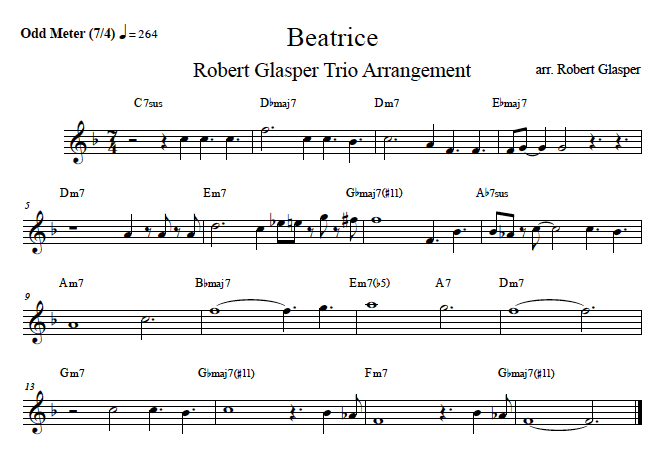
- Robert Glasper Trio arrangement of “Beatrice”
- Robert reharmonizes the chord changes, which gives the melody a new color
- For example: in bar 7, he changes the harmony from the original Dm7 to Gbmaj7, which changes the melody from being the minor 3rd to the major 7th
- Robert changes the meter from 4/4 to 7/4.
- Robert reharmonizes the chord changes, which gives the melody a new color
- Robert Glasper Trio arrangement of “Beatrice”
Fred Hersch Trio
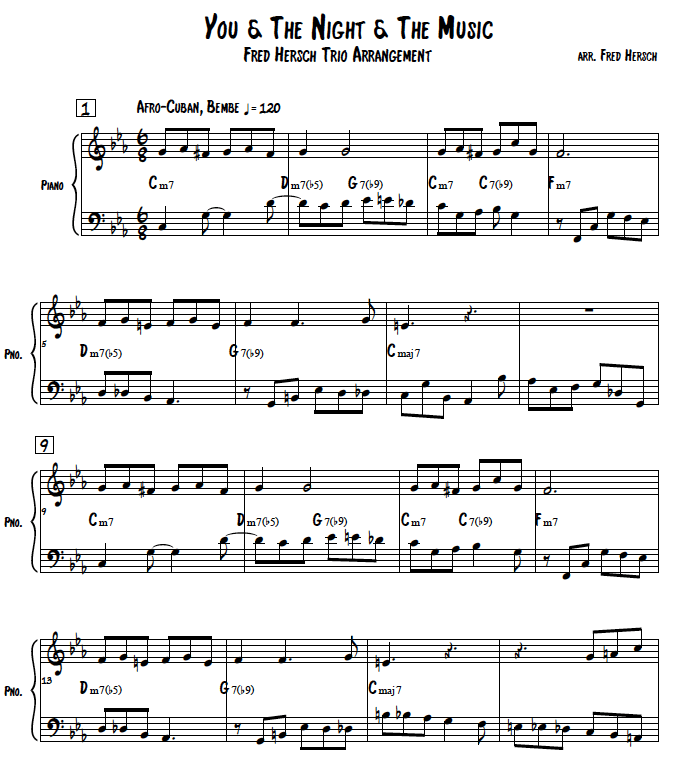
- Fred Hersch Trio arrangement of “You & the Night & the Music”:
- Fred changes the meter from the standard 4/4 swing, to a 6/8 Afro-Cuban feel
- Written-out bassline for the head that serves as a melodic counter-voice to the main melody
- During the 2nd solo section, the last A modulates from C minor to B minor
- After the solo section, the arrangement goes to a written out passage when trading 8’s with the drums
Click Here to See Entire Arrangement
Oscar Peterson Trio
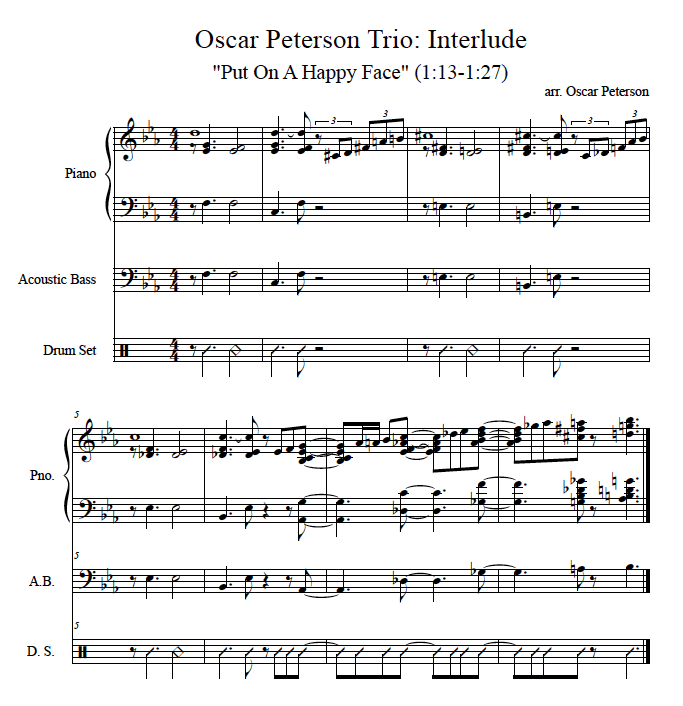
- Oscar Peterson Trio arrangement of “Put On A Happy Face”:
- Intro with a written-out bassline that functions as a groove
- Rhythmic hits that often coincide with chamber-like passages during the presentation of the melody
- Interlude propels into the solo section
- Intricate outro that includes rhythmic hits after the final presentation of the melody intended to provide closure to the arrangement
Links and Resources
Check out our FREE Beginner’s 5 Step Guide to Jazz Piano.
Do you want small, easy to use, efficient and effective jazz piano tools that you can learn within a week? Try The Lab with 21 Upgrade Formulas which are the core elements and jazz tools that will allow you to instantly upgrade any area of your playing.
Bijan Taghavi is a pianist, composer, and educator currently based in New York, NY. For more information visit http://www.BijanJazz.com.




7 Responses
I would be supremely interested.
Great basic ideas. Useful info.
superb job
Easy read thank you
Very usefull, I like this kind of education through examples 🙂
Thank you very much, that was very helpful.
Hi Helge, our pleasure! Glad we could help out!